12 Gift Exchange Ideas for Kids (Under $25, Any Kid Will Like)
Free printable
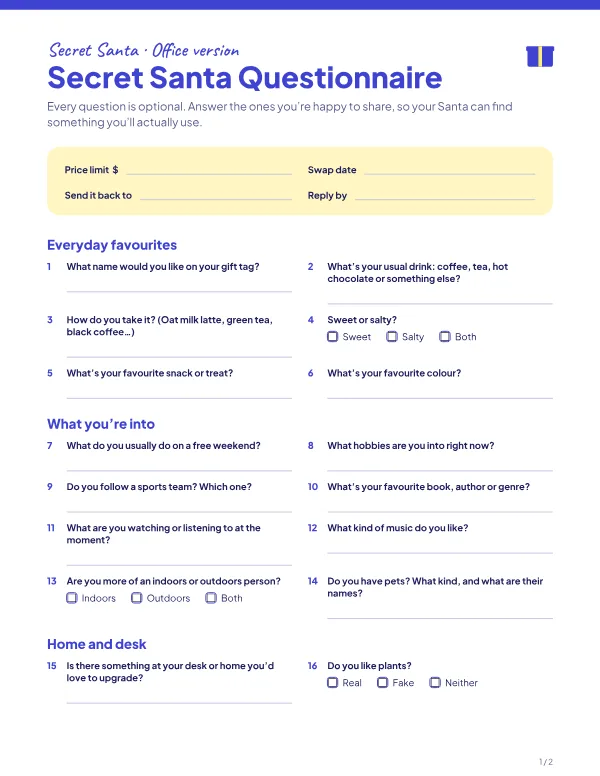
Secret Santa questionnaire
The questions as a fillable PDF. Type answers on screen or print it. Office, family and kids versions.
Our top picks
- Best for any ageSpot It! card game$10–$15Check price
- Most exciting to openNational Geographic break-open geodes (10 pack)$15–$20Check price
We may earn a commission if you buy through our links, at no extra cost to you. How we make money. Prices are typical ranges and change often, so check the retailer for today's price.
A kids' gift exchange has one rule that matters more than any other: every gift has to be something any child in the group would be happy to open. In a class party or a cousins' swap, the child who ends up with your gift might be five or twelve, a sports fan or a bookworm.
So every pick below is gender-neutral, works across a wide age range, and costs $25 or less, with most around $15. After the picks, you'll find the price limits that work for kids, the exchange games children enjoy most, and how to run a kids' draw alongside the adults'.
Under $25
Spot It! card game
$10–$15Every pair of round cards shares exactly one symbol, and the first player to spot it wins. It takes 30 seconds to learn, rounds last minutes, and a six-year-old can beat an adult. The small tin fits in a backpack, which is why it's a favourite for car trips and classroom gift exchanges alike.
- Best for
- Ages 6 and up, and whole families.
- Skip if
- The child already owns it. It's very common, so ask a parent if you can.
National Geographic break-open geodes (10 pack)
$15–$20Ten rough rocks, each with a crystal cavity inside, plus safety goggles and a learning guide. Kids crack them open themselves, which is the whole point: every one is a surprise. It's half science kit, half treasure hunt, and it appeals to kids who'd never ask for a science gift.
- Best for
- Ages 6 to 12, and curious kids who like a surprise.
- Skip if
- The exchange is in a flat with downstairs neighbours. Cracking geodes is noisy, so it's best done outside.
LEGO Creator 3in1 small set
$10–$20Each Creator 3in1 set builds three different models from the same bricks, such as a dragon, a fish or a phoenix. That triples the play value of a small box. LEGO appeals to almost every child from about six, and the bricks join whatever collection they already have.
- Best for
- Ages 6 to 12.
- Skip if
- A younger sibling under three will be around. The small pieces are a choking hazard.
Crayola Inspiration Art Case
$20–$28A fold-out case with around 140 crayons, coloured pencils, markers and paper, all organised in one box. It looks generous when opened, and it's useful to every child who likes drawing, which is most of them. The case keeps everything together afterwards, which parents appreciate.
- Best for
- Ages 4 to 10, and creative kids.
- Skip if
- They're over 11. Older kids usually want proper art supplies or a sketchbook.
Kinetic Sand sandbox set
$15–$20Kinetic Sand is mouldable sand that sticks to itself, not to hands or carpets, so it's much less messy than real sand. The set comes with a tray and moulds. It's absorbing for younger kids, and even older kids find it oddly relaxing to squish.
- Best for
- Ages 3 to 8.
- Skip if
- The parents have banned sand and slime from the house. Some families simply don't want it.
Guinness World Records (latest edition)
$15–$25Every year's edition is packed with photos of the tallest, fastest and strangest record holders, and kids read it cover to cover. It's also a book reluctant readers enjoy, because every page stands alone. It works for eight-year-olds and teenagers equally well.
- Best for
- Ages 7 to 14, especially reluctant readers.
- Skip if
- They get it every year from a grandparent. Choose a different book instead.
Sleeping Queens card game
$10–$13Designed by a six-year-old, Sleeping Queens is a quick card game about waking up queens with kings and protecting them from knights and potions. It involves a little simple maths, so it quietly practises adding up. Rounds take about 20 minutes, and it's charming enough that parents enjoy playing it too.
- Best for
- Ages 5 to 9.
- Skip if
- The child is over ten. They'll find it too simple.
Klutz Make Clay Charms
$20–$25Klutz craft kits come with a full instruction book and everything needed to finish the project. This one makes tiny food and animal charms from polymer clay that hardens in a home oven. Kids end up with something to keep or give away. It's a good gift for the crafty child who has too many colouring books.
- Best for
- Ages 8 to 12, and crafty kids.
- Skip if
- The child is under eight. The pieces are fiddly, and baking needs an adult.
Rubik's Cube
$8–$12A classic that's having a revival, thanks to speedcubing videos. The official Rubik's Cube turns smoothly and comes with a solving guide. It's a cheap, satisfying gift that older kids can spend weeks trying to master, and it fits easily into a small exchange budget alongside a second item.
- Best for
- Ages 8 and up, and puzzle-minded kids.
- Skip if
- The child gets frustrated easily. Give them a simpler puzzle, or choose a 2x2 cube.
Stomp Rocket
$20–$25Stomp on the air pad and a foam rocket shoots high over the house. There are no batteries, and it's safe for backyards. It gets kids outdoors and is fun for a group of cousins to share. Refill rockets are cheap, which matters because a few will end up on the roof.
- Best for
- Ages 5 to 10, and active kids.
- Skip if
- The child lives in an apartment with no yard or park nearby.
Black Diamond Wiz kids' headlamp
$20–$25A headlamp made for small heads, with a colourful strap and a simple button. Kids use it for camping, reading under the covers and exploring the house in a power cut. Black Diamond makes serious climbing gear, so this is a well-built product rather than a toy that breaks in a week.
- Best for
- Ages 3 to 10, and outdoorsy families.
- Skip if
- They already have a headlamp. One is plenty.
Kids' walkie-talkies (2 pack)
$20–$30A pair of simple walkie-talkies. The boxes often claim a mile or more, but expect less between houses. It gives kids an excuse to play spies, hide and seek, or check in from the backyard. A pair means siblings or cousins share the fun, which suits a family exchange where your gift might go to a household of children.
- Best for
- Ages 5 to 12, and siblings.
- Skip if
- The child is an only child who lives far from friends. Walkie-talkies need a second player.
Price limits for kids
Kids’ exchanges are almost always paid for by parents, so the limit has to suit every family, not just the ones who’d happily spend more.
| Exchange | Typical limit |
|---|---|
| School class party | $10 to $15 |
| Scout troop, club or team | $10 to $15 |
| Cousins’ draw in a family | $15 to $25 |
| Kids’ white elephant at a party | $10 to $20 |
For smaller limits, our list of gifts under $10 includes plenty that work for children. If you’re setting the limit for a group of families, the calculator in our guide to how much to spend on a gift exchange has a kids’ option.
The best exchange games for kids
Kids hate waiting, and they take losing a gift to a steal personally. So the best games for children keep everyone busy and have little or no stealing.
- The dice game. Everyone holds a gift and passes, swaps or unwraps depending on the roll, and a timer ends it.
- The plastic wrap ball. A giant ball of plastic wrap with small treats hidden inside. Players unwrap wearing oven mitts until the next person rolls doubles.
- Musical gifts. Pass gifts round while music plays. When it stops, you keep what you’re holding.
All three are explained in our list of gift exchange games. If older kids want a classic white elephant, use a two-steal limit and make sure every child ends up with something they’re happy with.
Running a kids’ draw alongside the adults’
In a family, the simplest setup is two draws: one for adults and one for kids, each with its own limit. Keep siblings apart in the kids’ draw, and let parents do the buying with their child choosing the gift. Our free Secret Santa generator can run both: set up the kids’ draw separately with its own budget, and send each family the link for their child. For the adults’ side, see our family gift exchange ideas.
A short wish list helps, even for kids. The kids’ version of our Secret Santa questionnaire asks simple questions like favourite colour, favourite animal and what they’re into right now. It comes as a free printable PDF that kids can fill in themselves.
Rules that keep a kids’ exchange fair
- No candy-only gifts. Food allergies are common, and a parent may have to take it away.
- No small parts if under-fives might be there. LEGO, beads and clay charms are for older kids.
- No gift cards. Kids want something to unwrap.
- Wrap in plain paper. Wrapping that screams “for a girl” or “for a boy” is a problem when you don’t know who’ll get it.
- Have a spare gift. Someone always forgets theirs, and no child should go home empty-handed.
For more ideas across all ages and budgets, see our main gift exchange ideas.
Frequently asked questions
What is a good price limit for a kids' gift exchange?
$10 to $20 is typical for class parties and cousins' swaps. For a school class, $10 or $15 keeps it fair for every family. Parents usually pay, so set a limit they're comfortable with.
What is a good gift exchange gift for any kid?
A simple game like Spot It! or Sleeping Queens, a craft or building kit, Kinetic Sand, or a surprise science kit like break-open geodes. These work for boys and girls across a wide age range.
What gift exchange game is best for kids?
The dice game, the plastic wrap ball and musical gifts are the favourites, because everyone is involved at once. Avoid long white elephant games with lots of stealing, which can end in tears.
Should kids draw names for a family gift exchange?
Yes, in a separate kids' draw at a lower limit. Keep siblings apart, and let parents help with shopping while the kids choose the gift.