White Elephant Rules: How to Play, Steal Limits and Variations
Free printable
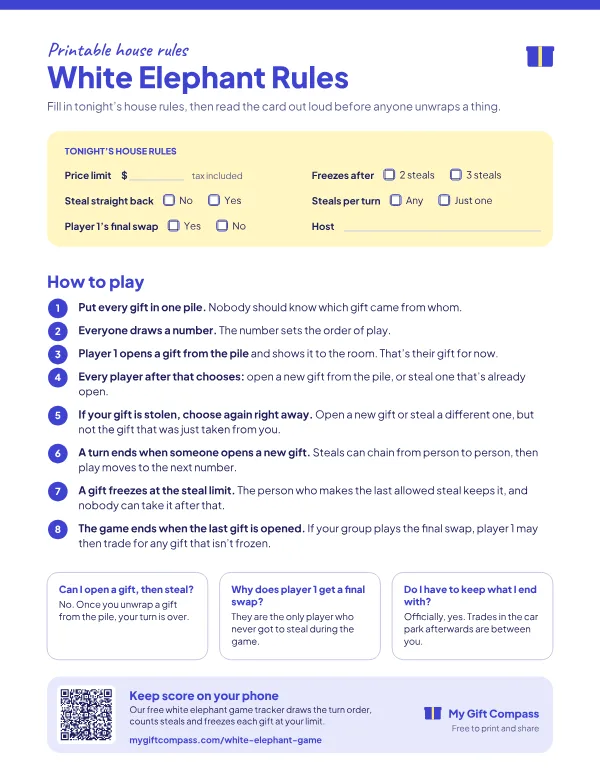
White elephant rules card
All the rules on one page, with tick boxes for your house rules: the steal limit, steal-backs and the final swap.
White elephant is the gift exchange where the gifts get stolen. It goes by other names too: Yankee swap in New England, Dirty Santa in the South, and Rob Your Neighbor or Thieves' Christmas elsewhere. The game is the same everywhere, and so are the arguments. Can you steal a gift straight back? Does the first player get another go? How many times can one gift change hands?
This page covers the standard rules first, then the house rules worth agreeing before anyone unwraps anything. After that come variations for large groups, families with kids and video calls. The whole point is that nobody should have to settle a rules dispute halfway through the party.
What you need before you start
- One wrapped gift per player. Plain wrapping hides what’s inside. If people bring gift bags, ask them to add tissue paper so nobody can peek.
- A price limit. Everyone brings a gift worth roughly the same amount, which is what makes stealing fair. Not sure what to set? See our guide to how much to spend on a gift exchange.
- Numbered slips of paper in a bowl, one for each player. A random number generator on a phone works too.
- House rules agreed in advance. Decide the steal limit and the end-of-game rule before the first gift is opened. Say them out loud, or put them in the invitation.
The standard rules, step by step
- Put every gift in one pile. Nobody should know which gift came from whom.
- Everyone draws a number. The number sets the order of play.
- Player 1 opens a gift from the pile and shows it to the room. That’s their gift for now.
- Player 2 chooses: open a new gift from the pile, or steal player 1’s opened gift.
- If your gift is stolen, you choose again right away. You can open a new gift from the pile or steal another opened gift, but you can’t take back the gift that was just stolen from you.
- A turn ends when someone opens a new gift. Steals can chain from person to person, but the chain stops as soon as someone picks from the pile. Then play moves to the next number.
- A gift freezes after its third steal. The third person to steal it keeps it, and nobody else can take it.
- The game ends when the last gift is opened. In most versions, player 1 then gets one final chance to swap their gift for any unfrozen gift, because they were the only player who never got to steal.
That’s the whole game. Everything else is house rules.
The house rules people argue about
These are the points that cause arguments halfway through the game. Settle each one before you start.
How many steals before a gift freezes? Three is the most common limit. With a big group, two keeps the game moving. With no limit at all, one popular gift can bounce around the room for twenty minutes.
Can you steal back immediately? The usual answer is no: you can’t take back the gift that was just taken from you on the same turn. Without this rule, two people can trade the same heated blanket back and forth forever.
Is there a limit on steals per turn? Some groups allow only one steal per turn. The person who loses their gift has to open a new one from the pile. That makes the game faster but less chaotic.
Does player 1 get a final swap? Most groups say yes, because otherwise the first number is the worst one to draw. If player 1 swaps with someone, that person keeps whatever they’re given, and the game is over.
Do you have to keep what you end up with? Officially, yes. Unofficially, plenty of trades happen in the car park afterwards, and nobody minds. Just don’t turn the private trading into a second game.
Can you open a gift and then steal instead? No. Once you unwrap a gift from the pile, your turn is over.
White elephant vs Yankee swap vs Dirty Santa vs secret Santa
| Name | How it works | Where you’ll hear it |
|---|---|---|
| White elephant | Pick from the pile or steal, with steal limits | Across the US, the most common name |
| Yankee swap | The same game | New England |
| Dirty Santa | The same game, often with funnier gifts | The South |
| Rob Your Neighbor | The same game | Parts of the Midwest |
| Secret Santa | You draw one person’s name and buy a gift just for them. No stealing | Offices, families, friend groups |
The key difference is between the first four and secret Santa. In a white elephant, you buy for the whole room, because anyone could end up with your gift. In secret Santa, you buy for one person. That changes what you should bring. For a steal-worthy gift, see our white elephant gift ideas. For a personal one, see our secret Santa gift ideas, and our guide to how to do Secret Santa if you’re organising one.
Variations worth trying
Dice white elephant. Everyone starts with a wrapped gift, and each roll of the dice means swap, pass or unwrap until a timer runs out. It works well for kids, who struggle with waiting for their turn.
Left-right story game. Everyone passes their gift left or right each time the words come up in a story read aloud. There’s no stealing, so it’s a gentle option for older relatives or mixed crowds.
Both games, with the full dice rules and eight more formats, are in our guide to gift exchange games.
Theme rounds. Everyone brings a gift in the same theme, such as “something cosy”, “something under $10 from a hardware store” or “the best book you read this year”. It gives shoppers some direction and stops the pile filling with candles.
Timer rule for huge groups. With more than 30 players, split into two circles, each with its own pile. Or use a two-steal limit and ban steals in the last five turns. Our guide to white elephant with a large group covers the rule changes, timings and room setup in full.
Playing white elephant on a video call
A virtual white elephant works the same way, with two changes.
- Deal with the gifts first. Either everyone ships their gift to the organiser, who opens each one on camera, or everyone buys an e-gift card or a gift from a shared shortlist. The winners’ gifts are then sent after the call.
- Show every gift clearly. Share a slide or a shared document with a photo of each gift as it’s opened. That way people can remember what’s on the table when they decide what to steal.
Keep the price limit a little lower for virtual games, because shipping often costs extra. For team games, our office secret Santa etiquette guide covers how to keep things inclusive for remote colleagues, and our virtual gift exchange ideas all ship well or arrive by email.
How long does it take?
Plan on one to two minutes per player, plus time for steals. For a quick game:
| Players | Steal limit | Typical length |
|---|---|---|
| Under 10 | 3 | 20 to 30 minutes |
| 10 to 20 | 3 | 30 to 45 minutes |
| 20 to 30 | 2 | 45 to 60 minutes |
| 30+ | 2, or split into two games | An hour or more |
Tips for the host
- Put the rules in the invitation, including the limit and the date. Repeat them before the first turn.
- Have one or two spare gifts in case someone forgets theirs or a guest turns up unexpectedly.
- Take the numbers seriously. Hand them out as people arrive, so latecomers don’t feel singled out.
- Print the rules. Our free printable white elephant rules card fits on one page and has tick boxes for your steal limit, steal-backs and the final swap. Tape it to the gift table.
- Let a phone keep score. Our free white elephant game tracker draws the turn order, counts steals, freezes each gift at your limit and runs the final swap, so nobody has to remember who stole what.
- Keep the pace up. If someone takes ages to decide, the room can count down from ten.
- Watch for anyone left out. If the same quiet person keeps losing gifts, the host can call “last steal” and move on.
What to bring
The gifts that get stolen are both funny and useful, or they’re from a brand everyone recognises. Pure joke gifts get left behind, which is why our funny white elephant gifts are all jokes worth stealing. For tried-and-tested ideas at every price limit, see our white elephant gift ideas and the wider list of gift exchange ideas. How a gift is wrapped matters more in white elephant than in any other exchange, and our hard-to-open gift wrapping ideas will add some chaos to the party.
Got an unwanted gift sitting in a drawer? A white elephant is one of the few places where regifting is fair game. Read is regifting rude? for the rules.
Frequently asked questions
How many times can a gift be stolen in white elephant?
Most groups freeze a gift after its third steal, so the third person to steal it keeps it. With more than 25 players, a two-steal limit keeps the game moving.
Can you steal a gift back right after it's stolen from you?
Not under the usual rules. When your gift is stolen, you can open a new gift or steal a different one, but not the one that was just taken from you. You can try to get it back on a later turn.
Does the first player get another turn in white elephant?
In most versions, yes. Player 1 never gets to steal during the game, so at the end they may swap their gift for any unfrozen gift. That swap ends the game.
What is the difference between white elephant and Yankee swap?
They are the same game under a regional name. Yankee swap is more common in New England. Some groups say Yankee swap gifts are more practical and white elephant gifts are funnier, but the rules are the same.
How long does a white elephant game take?
Allow one to two minutes per player, plus time for steals. A group of 15 usually finishes in 30 to 45 minutes, and 30 players can take well over an hour unless you lower the steal limit.